Observational Units and Variables: AP Statistics Practice
Three of six runs stayed on course from start to finish. One of three robots did it at least once. Both fractions come from the same fictional robotics club log. To see why the denominators differ, ask what each row represents.
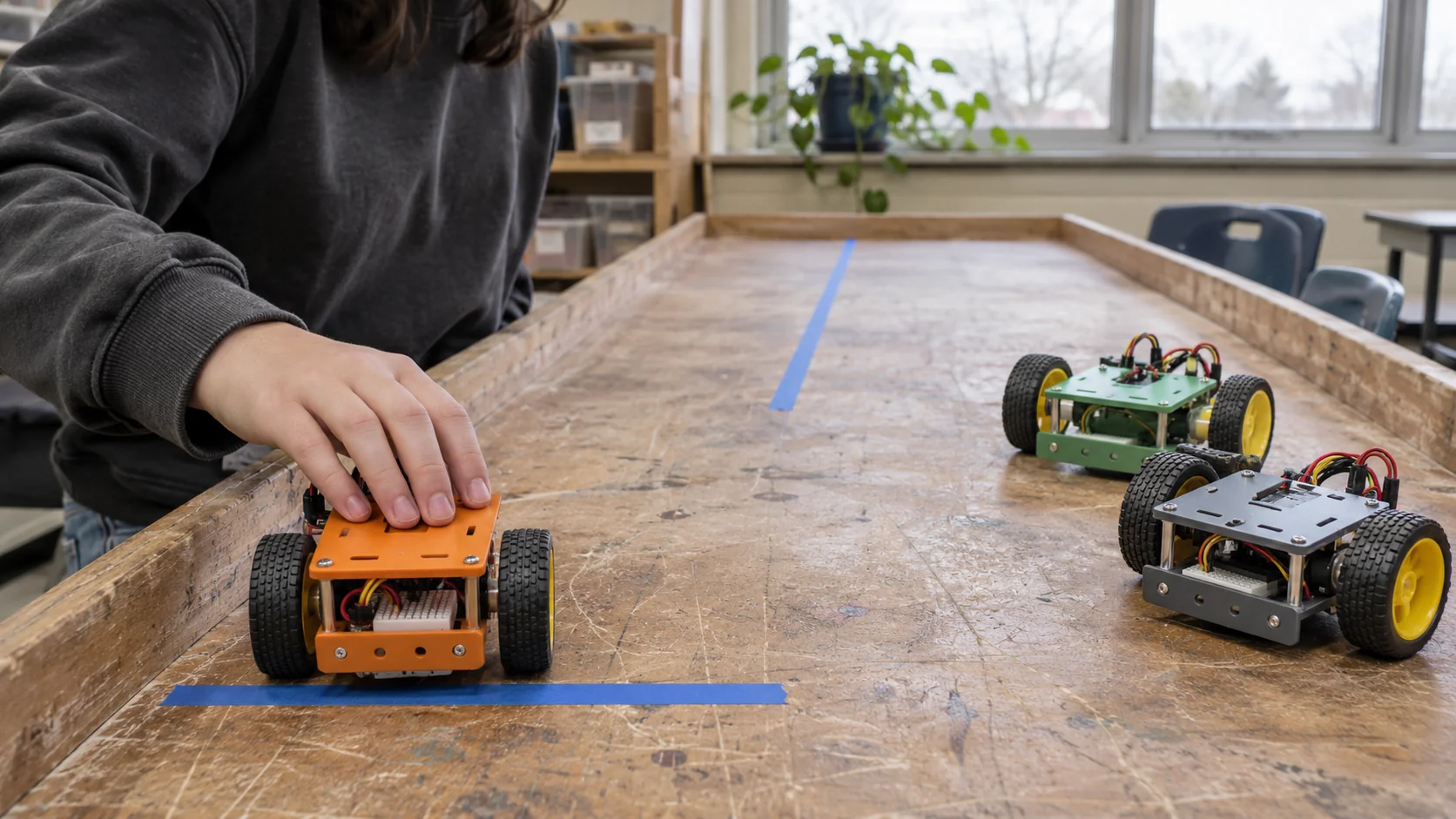
What does one row represent?
An observational unit is the person, object, group, or event you collect data about. A variable is a characteristic you record for each unit. A datum is one recorded value. In the table below, the first run is a unit, duration is a variable, and 42 seconds is the value recorded for that run. Identifying observational units and classifying variables are skills in AP Statistics Unit 1. College Board’s AP Statistics Course and Exam Description, Topic 1.2.A–B, printed page 32.
The club records one row each time a robot makes a run. Every recorded run reaches the finish, even if the robot leaves the marked path along the way. The club enters Yes only when the robot stays on the path from start to finish on that run.
| Run ID | Robot ID | Stayed on course throughout? | Duration (seconds) |
|---|---|---|---|
| 101 | A1 | Yes | 42 |
| 102 | A1 | Yes | 45 |
| 103 | A1 | No | 57 |
| 104 | A1 | Yes | 44 |
| 105 | B2 | No | 61 |
| 106 | C3 | No | 54 |
There are six observational units in this log, one per run. A1 appears four times because it made four recorded runs. Stayed on course throughout? is categorical because Yes and No name two outcomes. Duration is quantitative because it measures elapsed time in seconds. The IDs serve as labels. 101 identifies a run and A1 identifies a robot.
Count runs, then count robots
For “What fraction of recorded runs stayed on course throughout?”, count the Yes entries in the run log. Runs 101, 102, and 104 qualify, so the answer is 3/6, or 50%.
For “What fraction of the robots in the log had at least one run that stayed on course throughout?”, group the rows by robot ID. Make one summary row for each robot. Give that row a Yes if any of the robot’s recorded runs has a Yes.
| Robot ID | Observed runs | At least one run stayed on course throughout? |
|---|---|---|
| A1 | 4 | Yes |
| B2 | 1 | No |
| C3 | 1 | No |
The observational unit in this summary is one robot. Observed runs is a quantitative count, and At least one run stayed on course throughout? is categorical. Only A1 qualifies, so the answer is 1/3, or about 33%.
Both fractions describe what happened in this log. When you interpret “at least once,” keep the run counts in view. A1 had four chances to qualify, and B2 and C3 had one each. When you write a question of your own, name what you’ll count and what qualifies before picking a denominator. AP Statistics investigative questions.
Five practice questions
Try these fictional exercises before checking the answers.
- In the row for run 103, name the observational unit, the variable measured in seconds, and its recorded value. What does No mean in that row?
- Among recorded runs under 58 seconds, what fraction stayed on course throughout? Name the unit you’re counting and give the numerator and denominator.
- Add run 107 to the original log. B2 stays on course throughout and finishes in 56 seconds. What fraction of the runs now stayed on course throughout? What fraction of the robots now have at least one such run?
- A library records one row for each item borrowed, even when it issues two items in the same transaction. It records the member ID, item format (print or audiobook), and loan length in days. A member borrows three items in one visit, including two in a single transaction. How many rows does the visit add? What does each row represent, and how would you classify the three fields?
- A bus depot logs 12 departures across four routes. Two departures are late, both on the same route. What fraction of the routes in the log had at least one late departure? Describe what you would record in the summary row for the route that had the delays.
Worked answers
- A1’s run 103 is the unit. Duration is the variable, and 57 seconds is its recorded value. No means A1 left the marked path at some point during that run. It still reached the finish.
- 3/5 of the runs under 58 seconds. Five runs meet the time condition (101, 102, 103, 104, and 106), and three of those stayed on course throughout (101, 102, and 104).
- 4/7 runs and 2/3 robots. Adding run 107 brings the run count to seven and the Yes count to four. B2 now has one Yes in its two runs, so it joins A1 among the robots that qualify. The log still contains three distinct robot IDs.
- Three rows, one per item loan. Each row describes a single item being borrowed. All three rows carry the same member ID. Member ID is an identifying label, item format is categorical, and loan length is quantitative because it measures a number of days.
- 1/4 of the routes. Each route gets one row in the summary. The route with both delays gets a Yes for “At least one late departure?” The two late departures count toward the same route, which enters the numerator once.
Try the two fractions from memory
Tomorrow, cover the robot summary and try to recover both fractions from the original run log. Say what each denominator counts before checking your answer. Try the bus example again a few days later. Each time, work out the answer before peeking. Bringing a method back to mind after a gap can help you remember it longer. Research on spaced retrieval. For more prompts on identifying units and classifying variables, use the English AP Statistics flashcard deck.
AI drafted the text and exercises and generated the illustration.